
Dropshipping has gone through more reinventions in the past three years than in the decade before it. The latest shift, building an AI dropshipping store, has entrepreneurs asking a fair question: is this actually a better way to run an e-commerce business, or is it just the traditional model with a chatbot bolted on?
The honest answer is that it depends on what you're optimizing for. This article breaks down the real differences between AI-powered dropshipping stores and traditional dropshipping setups, with timelines, cost ranges, and tool comparisons, so you can make an informed decision rather than a hype-driven one.
What Is an AI Dropshipping Store, Really?
An AI dropshipping store uses machine learning tools and automation agents at multiple stages of the business, not just customer service chatbots. That includes:
- Product research: AI tools that scan trend data, ad libraries, and marketplace signals to surface winning products before they saturate
- Store building: AI website generators that create product pages, descriptions, and layouts in minutes
- Content creation: AI-generated images, videos, and ad copy for marketing
- Customer support: AI chat agents that handle FAQs, order tracking, and returns
- Analytics and scaling: AI-driven insights that flag which products or ads to scale or kill
Traditional dropshipping, by contrast, relies on manual research, template-based store builders, freelance writers or designers, and human-run customer service. It's not that traditional dropshipping doesn't use software. It's that the decision-making is almost entirely human-driven.
The distinction matters because it changes where your time and money go. When I write about these workflows, the question I keep coming back to is which AI touchpoints actually move the needle and which ones just add cost without improving results. If you want the broader picture first, start with AI Dropshipping: What It Is, Where AI Helps, and How to Build a Workflow.
Speed to Launch: AI Tools vs. Manual Setup
One of the clearest differences between the two models is how fast you can get a store live and selling. The ranges below are rough planning estimates, not guarantees. Your own numbers will depend on your niche, your skills, and the tools you pick.
| Task | Traditional Approach | AI-Assisted Approach |
|---|---|---|
| Niche/product research | 10–20 hours of manual scrolling and spreadsheets | 1–3 hours using AI research tools |
| Store build (theme, pages, copy) | 15–25 hours | 3–6 hours |
| Product descriptions (50 SKUs) | 8–12 hours (writing or outsourcing) | 1–2 hours |
| Ad creative production | 5–10 hours | 1–3 hours |
| Total time to launch | 40–65 hours | 8–14 hours |
The AI-assisted approach isn't just faster. It changes the economics of testing. When launching a store takes a couple of days of work instead of a couple of weeks, you can afford to test more niches and kill underperformers faster, which is arguably the single biggest lever in dropshipping profitability.
That said, speed isn't the same as quality. A store built quickly with AI tools still needs human judgment to avoid generic branding, awkward AI-written copy, or products that look good in a research tool but have no real market pull.
Cost Comparison: Where the Money Actually Goes
A common assumption is that "AI tools" automatically mean higher software costs. In practice, the cost structure shifts rather than simply growing. As with the time estimates, treat these as typical ranges, not quotes.
| Expense Category | Traditional Dropshipping (Monthly) | AI-Powered Dropshipping (Monthly) |
|---|---|---|
| Store platform (Shopify, etc.) | $29–$79 | $29–$79 |
| Product research tools | $0–$50 (manual or basic tools) | $30–$99 (AI research platforms) |
| Content/copywriting | $200–$600 (freelancers) | $20–$60 (AI writing tools) |
| Customer support | $300–$1,000+ (VA or agency) | $0–$150 (AI chat agents) |
| Ad creative production | $150–$500 (designer/editor) | $0–$80 (AI image/video tools) |
| Estimated Total | $679–$2,229 | $79–$468 |
The biggest savings show up in labor-replacement categories: copywriting, customer support, and creative production. These were traditionally outsourced to freelancers or virtual assistants, and AI tools now handle a meaningful share of that volume. Not all of it, but enough to change the math for a solo operator or small team. For a closer look at which tools are worth paying for, see Which AI Tools for Dropshipping Actually Save You Time in 2026?
It's worth noting that cost savings only turn into profit if the output quality holds. A cheap AI writing tool that produces copy nobody reads isn't actually cheaper. It's just a smaller line item attached to a bigger problem.
Product Sourcing: Can AI Actually Find Better Products?
This is where the gap between hype and reality is widest. AI product sourcing tools analyze signals like ad spend patterns, search trend velocity, and social engagement to flag potential winners. Used well, they're genuinely useful for narrowing a long list of possible products down to a handful worth investigating.
Where they fall short is validation. No AI tool today can tell you with certainty that a product will sell in your specific store, to your specific audience, at your specific price point. That still requires testing.
A practical workflow looks like this:
- Use an AI sourcing tool to generate a shortlist based on trend and demand signals
- Cross-check shortlisted products against supplier reliability and shipping times
- Validate manually by checking competitor ad libraries and marketplace reviews
- Launch small test campaigns on modest daily budgets across a few products
- Scale only the products with proven click-through and conversion data
I cover this approach in more depth in How to Use AI Product Sourcing to Find Winning Items Before Your Competitors Do, where the emphasis is on using AI to narrow the field, not to make the final call. Free trend data and public ad libraries are still useful complements to any paid research platform.
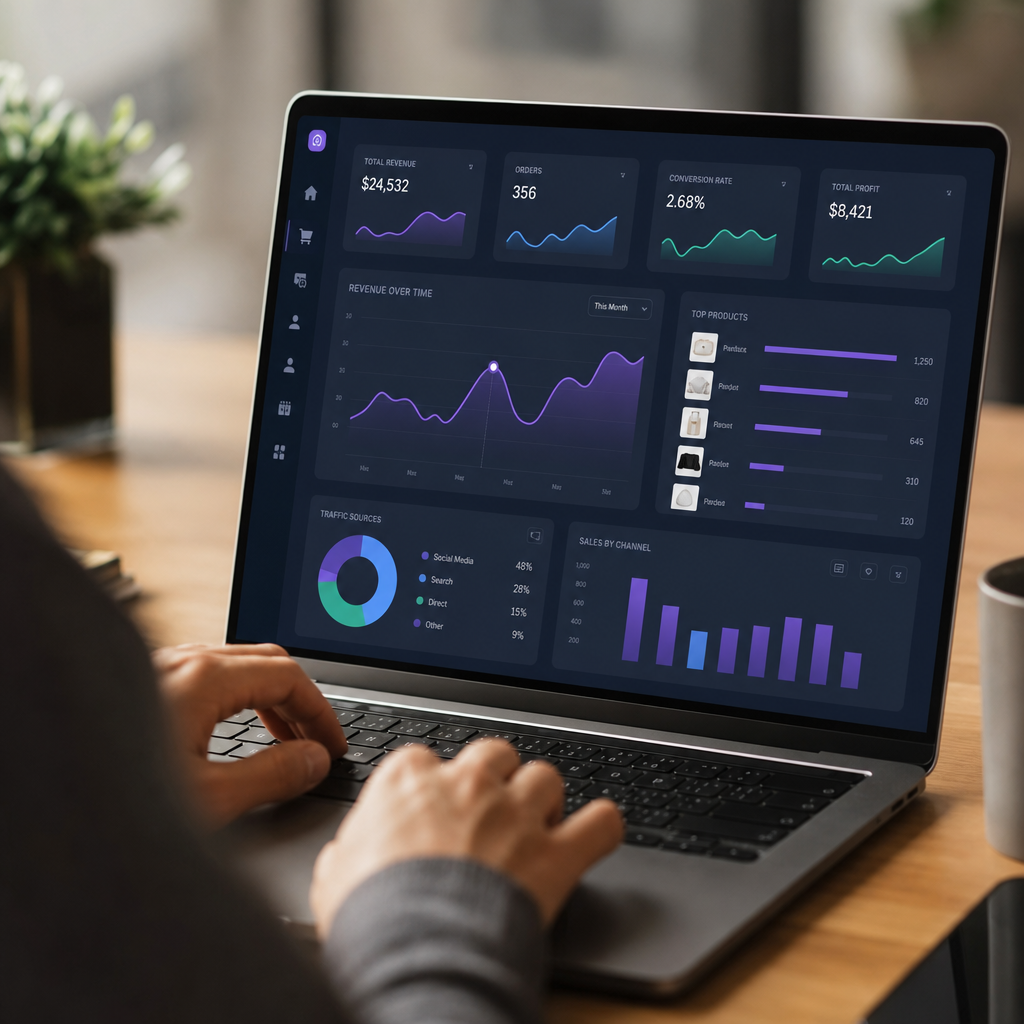
Store Building and Design: Template Automation vs. AI Generation
Traditional store building usually means picking a theme from Shopify's theme store, customizing it manually, and writing or outsourcing product descriptions. It's reliable but slow, and the end result often looks like dozens of other stores using the same theme.
AI store builders go a step further by generating layouts, suggesting product groupings, and writing initial draft copy from a short prompt. Shopify has built AI features directly into its dashboard for product descriptions and basic design suggestions, and standalone AI website builders can spin up a near-complete store from a product catalog quickly.
The tradeoffs:
Traditional template building:
- Pros: Full creative control, proven reliability, large plugin ecosystems
- Cons: Time-intensive, requires design sense, outsourcing adds cost
AI-generated store building:
- Pros: Fast first draft, lowers the skill floor for non-designers, reduces upfront cost
- Cons: Generic output without editing, occasional factual errors in AI-written copy, still requires human polish
Neither approach removes the need for a human eye on the final product. The stores that convert best in 2026 tend to use AI for most of the first draft and a careful human pass at the end: adjusting tone, fixing awkward phrasing, and making sure the brand doesn't look like a template with a different logo. If you want a step-by-step version of that process, I walk through it in Build Your First AI-Run Store in a Weekend.
Customer Support and Operations: Where AI Agents Earn Their Keep
Customer support is arguably the clearest win for AI in dropshipping. Order status questions, shipping delays, and basic product questions make up the bulk of support tickets, and AI chat agents handle this volume well when they're properly configured with store-specific data.
| Support Function | Human-Only Support | AI Agent Support |
|---|---|---|
| Response time | Minutes to hours | Instant |
| Availability | Business hours typically | 24/7 |
| Cost per ticket | Scales with VA or agency hours | Platform fees, usually far lower per ticket |
| Handles complex complaints | Yes, well | Needs human escalation |
| Consistency of tone | Variable | Highly consistent |
The best setups use AI agents as a first line of response, with clear escalation paths to a human for refunds, complaints, or anything emotionally charged. Fully removing humans from support tends to backfire. Customers can tell, and frustration compounds when a bot can't resolve a real problem.
Beyond customer-facing support, AI is increasingly used for back-office work too: billing, order follow-ups, and retention flows that bring customers back for a second purchase. I run my own businesses on AI agents, and the same rule holds there. Automate the repetitive work, and keep a person on anything where a wrong answer costs trust or money.
Scaling to $10K Months: Where the Two Models Diverge Most
Launching a store is one thing. Scaling it profitably is another, and this is where the AI vs. traditional comparison gets more nuanced.
Traditional scaling relies heavily on manual ad account management, spreadsheet-based profit tracking, and human intuition about when to scale a winning campaign. It works, but it's slow to react. A human checking metrics twice a day misses the ad-spend swings that happen in between.
AI-assisted scaling uses automated rules and predictive analytics to:
- Flag underperforming ads for pausing within hours, not days
- Suggest budget reallocation based on real-time ROAS trends
- Predict inventory needs based on sales velocity
- Identify upsell and cross-sell opportunities from purchase data
Here's a simplified comparison of how the two approaches tend to differ:
| Metric | Traditional Scaling | AI-Assisted Scaling |
|---|---|---|
| Time to detect a losing ad | Often a day or more, between manual checks | Hours, once automated rules are set |
| Wasted ad spend | Higher, since losers keep running between checks | Lower, if rules pause losers early |
| Time spent on daily analytics | Full manual dashboard review | Shorter review of flagged items |
| Path to a first $10K month | Depends on niche and execution | Depends on niche and execution, with a faster feedback loop |
None of this is a guarantee. Market conditions, niche competition, and execution quality still matter more than any single tool. But the direction is clear: AI-assisted scaling shortens the feedback loop, and in a business where margin often comes down to days of wasted ad spend, that adds up. I go deeper on this stage in From First Sale to First $10K Month.

Risks and Limitations of Going All-In on AI
It would be irresponsible to present AI dropshipping as a strictly better model without naming its failure modes.
- Generic branding: Stores built almost entirely with AI tools often look and sound similar, which hurts trust and conversion
- Over-reliance on automation: Scaling rules without human oversight can amplify losses just as fast as they amplify wins
- Data quality issues: AI sourcing tools are only as good as the data behind them, and viral trends can mislead algorithms as easily as humans
- Customer trust: Shoppers are increasingly aware of AI-generated content and support, and poor implementation can feel impersonal. Google's guidance on helpful content is a good reminder that unedited, low-value automated pages don't serve readers or rankings
- Platform dependency: Many AI tools are new entrants with uncertain longevity, unlike established store platforms such as Shopify or WooCommerce
The stores that perform best treat AI as a force multiplier for a human-led strategy, not a replacement for one. That's the same theme I come back to in 7 Ways to Use AI for Dropshipping Without Wasting Money on Hype: the tools are only as good as the operator directing them.
Which Model Should You Actually Choose?
For most new entrepreneurs entering dropshipping in 2026, a hybrid approach beats going fully traditional or fully AI-automated:
- Use AI for research and first drafts: product shortlisting, initial copy, and basic design
- Apply human judgment for validation: competitor checks, pricing strategy, brand voice
- Automate support with escalation paths: AI handles volume, humans handle nuance
- Use AI analytics for faster scaling decisions, but review and approve major budget shifts manually
- Reinvest time savings into testing more products, since faster iteration is the real competitive advantage
If you're bootstrapping with limited time, the AI-assisted model's lower cost and faster launch timeline make it the more practical starting point. If you have capital to outsource quality control and want maximum brand differentiation from day one, a more traditional, human-heavy build may still make sense. Just expect a slower, more expensive path to your first profitable month.
Final Thoughts
The AI dropshipping store isn't a gimmick, but it's also not a magic shortcut to passive income, and anyone promising that isn't being straight with you. What it offers is a real reduction in the time and cost needed to launch, test, and refine an online store, as long as the operator still applies judgment at the key decision points: product validation, brand voice, and scaling discipline.
That's the lens I use for everything I write here: keep what works, drop what doesn't, and don't let a tool make a call that a person should make. Whether you're launching your first store or pushing an existing one toward consistent $10K months, the rest of my articles cover sourcing, store building, and scaling in more depth, so you can build on evidence rather than assumptions.