
Finding a winning product used to mean hours of scrolling through ad libraries, guessing at trends, and hoping a supplier could actually deliver on time. That process is changing fast. AI product sourcing now lets store owners analyze large amounts of data, cross-reference supplier reliability, and spot emerging demand before it shows up in mainstream trend reports. For anyone building a lean e-commerce business in 2026, knowing how to apply AI to sourcing isn't optional anymore. It's the difference between guessing and knowing.
This article breaks down how AI product sourcing works, which tool categories are worth your time, and how to build a repeatable workflow that doesn't rely on hype or luck. If you want the agent-driven version of this process, I walk through it in How I Use AI Agents to Find Winning Products.
What AI Product Sourcing Actually Means
AI product sourcing means using machine learning models, natural language processing, and automated data aggregation to identify, evaluate, and vet products for resale, typically for dropshipping, print-on-demand, or private label stores. Instead of manually checking marketplace bestseller lists or scrolling TikTok for hours, AI tools scan large datasets across marketplaces, social platforms, and ad networks to surface patterns humans would miss or take weeks to find.
At a practical level, this includes:
- Trend detection: identifying rising search volume or social engagement before a product saturates
- Supplier matching: pairing a product idea with vetted manufacturers or wholesalers
- Demand forecasting: predicting seasonal or regional demand shifts
- Competitive analysis: scanning competitor stores and ad activity to gauge market saturation
- Price and margin modeling: calculating realistic landed cost against retail price
The goal isn't to let an algorithm pick your product for you. It's to compress research time from days into minutes, so you can spend more energy on testing, validating, and building a brand around what actually sells.
Why Traditional Sourcing Methods Are Falling Behind
Manual sourcing isn't dead, but it's slower and less reliable in a market where trends can peak and crash within a few weeks. Here's how traditional methods compare with AI-assisted sourcing on the things that matter to store owners.
| Factor | Traditional Manual Sourcing | AI-Assisted Sourcing |
|---|---|---|
| Time to identify a viable product | Many hours of manual browsing each week | Much less, with tools doing the first pass |
| Data sources analyzed | A handful, checked by hand | Many, aggregated automatically |
| Trend detection speed | Reactive (after saturation) | Proactive (early-stage signals) |
| Supplier vetting | Manual messaging, slow replies | Automated scoring, reviews, response time tracking |
| Scalability across niches | Limited by the researcher's bandwidth | Runs across many niches in parallel |
| Risk of chasing dead trends | High | Lower, if signals are cross-checked |
The core problem with manual sourcing is that by the time a product shows up on a "winning products" list or a viral TikTok, plenty of other sellers have already seen it too. AI tools shrink the discovery window by scanning early-stage signals like rising search queries, search trend velocity, and new supplier listing activity before a product becomes widely visible.
Rising search interest often shows up before a product floods ad feeds and bestseller lists. That gap is what AI sourcing tools are built to catch, though how long it lasts varies a lot from product to product.
Core AI Tools Used for Product Sourcing in 2026
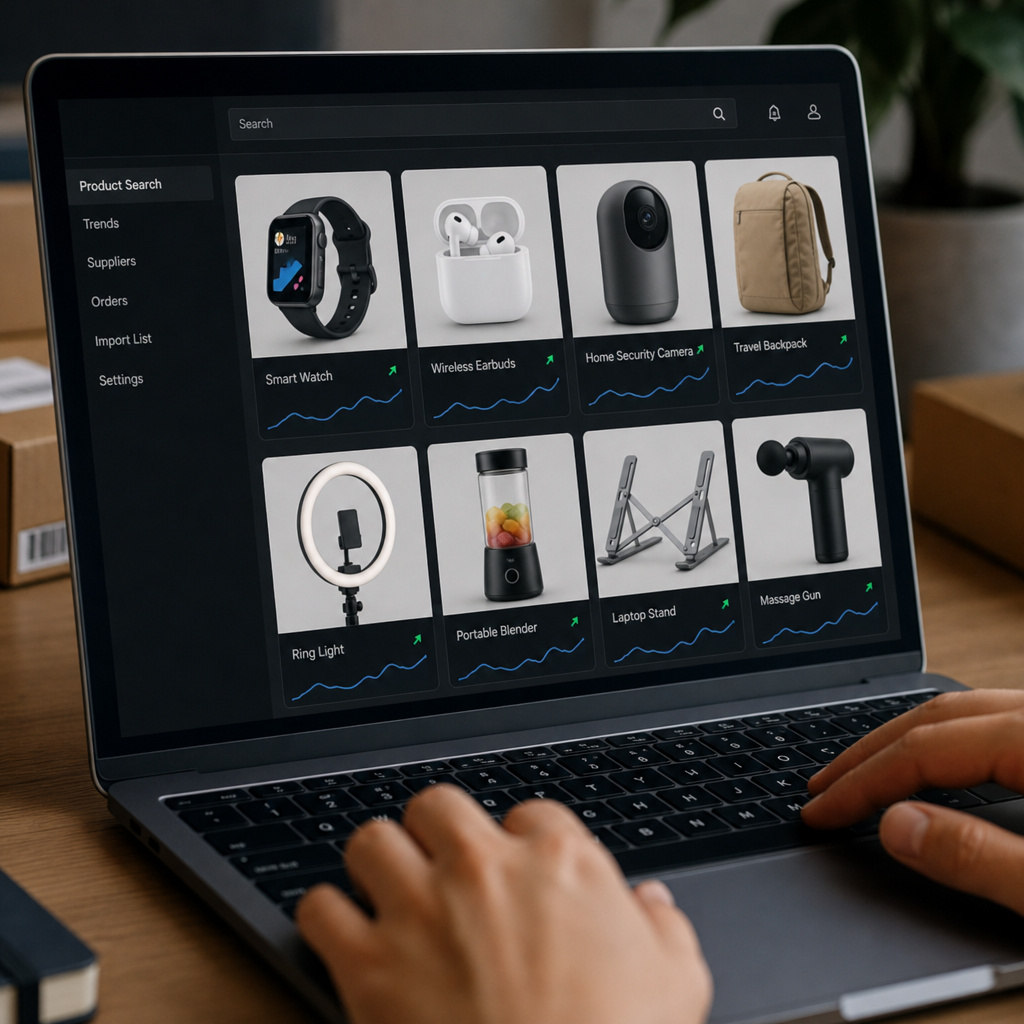
The AI sourcing landscape has matured. Rather than one "magic tool," most sellers now combine a small stack of purpose-built systems. Here are the categories worth knowing.
1. Trend and Demand Analysis Tools
These tools scan social platforms, search engines, and marketplaces to detect rising product categories. They typically use natural language processing to read comment sentiment and engagement velocity rather than just raw view counts.
2. AI Supplier Matching Platforms
Rather than manually messaging ten suppliers on a wholesale marketplace, these platforms use transaction history, response-rate scoring, and automated translation to filter out unreliable manufacturers before you ever make contact.
3. Store and Listing Optimization Agents
Once you've sourced a product, AI copywriting and image-generation tools help build listings, generate ad creative variations, and localize content for different markets. I cover how these pieces fit together in The AI Tool Stack I Use to Run a Lean Store.
4. Forecasting and Inventory Models
For sellers moving from dropshipping into light private labeling, AI forecasting tools predict demand curves based on seasonality, competitor stock levels, and historical sell-through, which lowers the risk of overordering.
Building a Repeatable AI Sourcing Workflow
A tool is only as good as the process around it. Here's a practical five-step workflow for sourcing products with AI without falling into the trap of chasing shiny dashboards.
- Define your niche parameters first. Before touching any tool, decide on price range, shipping constraints, and target margin. AI tools work far better with narrow constraints than with "find me anything that sells."
- Run trend discovery across two or three platforms. Cross-reference signals from social platforms, search trend data, and marketplace bestseller data rather than relying on a single source.
- Score supplier reliability before committing. Use automated supplier scoring to check response time, fulfillment history, and dispute rates.
- Validate with a small-budget ad test. AI can surface a promising product, but real validation still comes from spending a small, controlled ad budget and measuring actual click-through and conversion data.
- Automate the re-sourcing loop. Set up recurring AI scans (weekly or every other week) so you're not repeating steps one through three by hand every time you need a new product idea.
The emphasis throughout is testing before scaling, not trusting a tool's output blindly. If you want to put this into a store from scratch, Build Your First AI-Run Store in a Weekend covers the full setup.
Comparing Popular AI Sourcing Tool Categories
The right combination of tools depends on your business stage. Here's how the common categories compare.
| Tool Category | Best For | Typical Cost Range (Monthly) | Learning Curve |
|---|---|---|---|
| Trend/demand scanners | New store owners validating first products | $20 to $80 | Low |
| Supplier matching platforms | Sellers scaling past 50+ orders/week | $0 to $150 (often commission-based) | Medium |
| Forecasting/inventory AI | Private label or bulk-inventory sellers | $100 to $500+ | High |
| AI listing/ad creative generators | Any stage, especially solo operators | $15 to $60 | Low |
Pricing changes often, so treat these ranges as rough. Most lean operators don't need every category at once. A smart starting point is a trend scanner paired with an AI listing generator: low cost, low complexity, and enough signal to validate first product ideas before investing in heavier forecasting tools.
If you're comparing specific platforms, Shopify's overview of dropshipping tools is a reasonable place to see what works with a store before you commit to anything.
Common Mistakes When Using AI for Product Sourcing
Even with good tools, sellers keep making the same errors. Avoiding these saves time and ad budget.
- Treating AI output as guaranteed demand. A tool flagging a product as "trending" means search or social interest is rising, not that profitable conversion is guaranteed. You still need a validation test.
- Ignoring supplier red flags because the product data looks good. A great product score means nothing if the supplier regularly ships late.
- Over-relying on a single data source. Tools trained mostly on one platform's data can miss the broader market picture you get from marketplace-wide sales data and general e-commerce research.
- Skipping margin math. AI trend tools rarely account for your specific shipping costs, payment processing fees, or return rates. Always run your own numbers before committing ad spend.
- Scaling too fast on thin data. A product that does well on a small test budget needs a second, larger test before you commit serious inventory or ad spend.

How AI Sourcing Fits Into a Lean E-Commerce Strategy
The bigger value of AI product sourcing isn't just speed. It supports a leaner operating model overall. A lot of traditional dropshipping advice emphasized volume: list hundreds of products and see what sticks. AI sourcing flips that by letting a small team, often just one person, run sharper and faster validation cycles with far less wasted testing budget.
This matters because paid traffic isn't cheap, and every ad test spent on an unvalidated product is budget you don't get back. A sharper sourcing process directly protects margin.
In practice, this means:
- Fewer products tested, each with more confidence going in
- Lower customer acquisition cost from better-targeted first creative
- Faster feedback loops between sourcing, testing, and scaling decisions
- More time for brand-building and retention instead of constant product churn
It's the same lean approach I come back to in From First Sale to First $10K Month: realistic paths toward sustainable revenue rather than one-off viral wins.
Evaluating Whether an AI-Sourced Product Is Actually Worth Testing
Before committing budget to any AI-flagged product, run it through a simple checklist. This keeps the process disciplined rather than reactive.
- Search trend trajectory: Is interest rising steadily, or did it spike once and flatten?
- Supplier reliability score: Does the supplier have a consistent fulfillment history, or very little data?
- Margin after landed cost: Does the product still clear a healthy margin after shipping, fees, and returns?
- Competitive saturation: How many existing ads or listings already target this exact product?
- Fit with your store's existing audience: Does this product match what your current customers already buy, or does it mean building a brand from scratch?
Products that score well on all five are worth a controlled test. Products that only look good on trend data are higher risk and should be treated as experiments, not core inventory bets.
Frequently Asked Questions About AI Product Sourcing
Is AI product sourcing only useful for dropshipping?
No. Dropshipping sellers benefit most from the speed, but private label and wholesale sellers use AI sourcing mainly for demand forecasting and supplier vetting rather than rapid product rotation.
Do I need coding skills to use AI sourcing tools?
Most modern tools have no-code interfaces built for e-commerce sellers. Some advanced forecasting platforms offer API access for custom integrations, but you don't need it to get started.
How much should I budget monthly for AI sourcing tools as a beginner?
Many beginners can run a useful stack for roughly $30 to $80 a month with a trend scanner and a listing or creative generator, and add more only once revenue justifies it.
Can AI replace manual product validation entirely?
No. AI narrows the field and surfaces opportunities faster, but real ad testing and conversion data are still the final check before scaling any product.
Final Thoughts on Building a Smarter Sourcing Process
AI product sourcing isn't a shortcut to guaranteed winners. It's a way to compress research time, cut wasted ad spend, and make faster, better-informed decisions about what to test next. The sellers who get the most out of it treat AI as a research accelerant rather than a decision-maker, and pair what the tools find with disciplined validation before scaling.
If you're building an e-commerce business on real workflows rather than guesswork, the rest of my articles go deeper on product sourcing, store building, and scaling a lean store.