
Dropshipping has always rewarded speed and information. Whoever finds the winning product first, writes the sharpest ad copy, and responds to customers fastest tends to win the margin war. In 2026, the biggest shift in that race is the arrival of AI tools and autonomous agents that can do large chunks of that work in minutes instead of days. That shift has a name now: AI dropshipping.
This article breaks down what AI dropshipping actually means, which tasks AI genuinely improves, which parts of the business still require a human, and how to build a realistic, tested workflow instead of chasing hype. It draws on the e-commerce workflows I've tested and written about on this site, shared in detail rather than sold as shortcuts. (If you want my take on how the model itself changed this year, start with AI-Powered Dropshipping in 2026: What Actually Works Now.)
What Is AI Dropshipping, Really?
AI dropshipping is not a new business model — it's the same dropshipping model (sell products you don't hold inventory for, fulfilled by a third-party supplier) but with AI tools embedded into the workflow at nearly every stage:
- Product research using AI to analyze trends, search volume, and competitor data
- Store building using AI website generators and copywriting assistants
- Content creation using AI for product descriptions, ad creative, and video scripts
- Customer service using AI chatbots and automated email responders
- Operations using AI agents that monitor inventory, pricing, and supplier reliability
The key distinction worth understanding: AI doesn't replace the dropshipping fundamentals. Margins, supplier quality, shipping times, and customer trust still determine whether a store survives. What AI changes is the speed at which you can test, iterate, and manage those fundamentals. According to Shopify's own research on commerce trends, store owners who integrate automation into daily operations report significantly more time spent on strategy versus repetitive tasks.
Where AI Actually Helps in Dropshipping
Not every part of the AI dropshipping pitch holds up under scrutiny. Here's a realistic breakdown of where the technology delivers measurable value versus where it's mostly marketing noise.
1. Product Sourcing and Trend Detection
AI tools can scan thousands of listings, social posts, and search trends far faster than a human scrolling TikTok for three hours. Tools that combine large language models with trend APIs can flag rising product categories before they saturate.
2. Store Copy and Product Descriptions
Writing fifty unique, conversion-focused product descriptions used to take a full day. AI drafting tools can produce a strong first pass in minutes, which a human then edits for accuracy and brand voice.
3. Customer Support Automation
AI chatbots trained on your FAQ and order data can resolve the majority of "where is my order" and sizing questions without human intervention, freeing up time for escalations that actually need judgment.
4. Ad Creative Variations
Generating ten variations of an ad headline or thumbnail used to require a designer or long manual testing. AI creative tools can produce variations quickly for A/B testing, although performance still needs human review.
5. Financial Organization
As orders scale, keeping track of supplier payments, ad spend, and revenue across multiple platforms becomes a real operational burden. Set up simple bookkeeping early, because AI product tools don't handle it.
| Task | AI Impact | Human Role Still Required |
|---|---|---|
| Product research | High — speeds up trend spotting | Validating margins & supplier quality |
| Store copywriting | High — fast first drafts | Brand voice, accuracy editing |
| Customer support | Medium-High — handles routine tickets | Complex complaints, refunds |
| Ad creative | Medium — fast variations | Strategic targeting, budget decisions |
| Supplier vetting | Low — AI can't verify real-world reliability | Direct communication, sample testing |
| Bookkeeping | Low (unless using dedicated tools) | Tax filing, financial strategy |
Building an AI-Powered Dropshipping Workflow
A workflow matters more than any single tool. Below is a simplified, sequential version of the process I cover in depth in Build Your First AI-Run Store in a Weekend, broken into stages so you can see where AI slots in naturally.
- Niche selection — Use AI research tools to analyze search demand, competition density, and seasonal patterns across candidate niches.
- Product validation — Cross-check AI-suggested products against real supplier data (pricing, shipping time, reviews) before committing inventory or ad budget.
- Store build — Use AI-assisted website builders or templates to launch a clean, mobile-optimized store quickly, then manually refine checkout flow and trust signals.
- Content generation — Draft product pages, email flows, and ad copy with AI, then edit for compliance and brand tone.
- Launch and test — Run small ad budgets across 2-3 creative variations, letting AI tools flag early winners based on click-through and conversion data.
- Scale and automate — Layer in chatbots, automated email sequences, and reporting dashboards once a product proves profitable.
- Financial tracking — Set up systems to keep cash flow and expenses organized as volume increases.
This sequence isn't theoretical — it mirrors the order of operations recommended by most experienced operators because skipping steps (especially validation) is the single biggest reason AI-assisted stores fail fast.
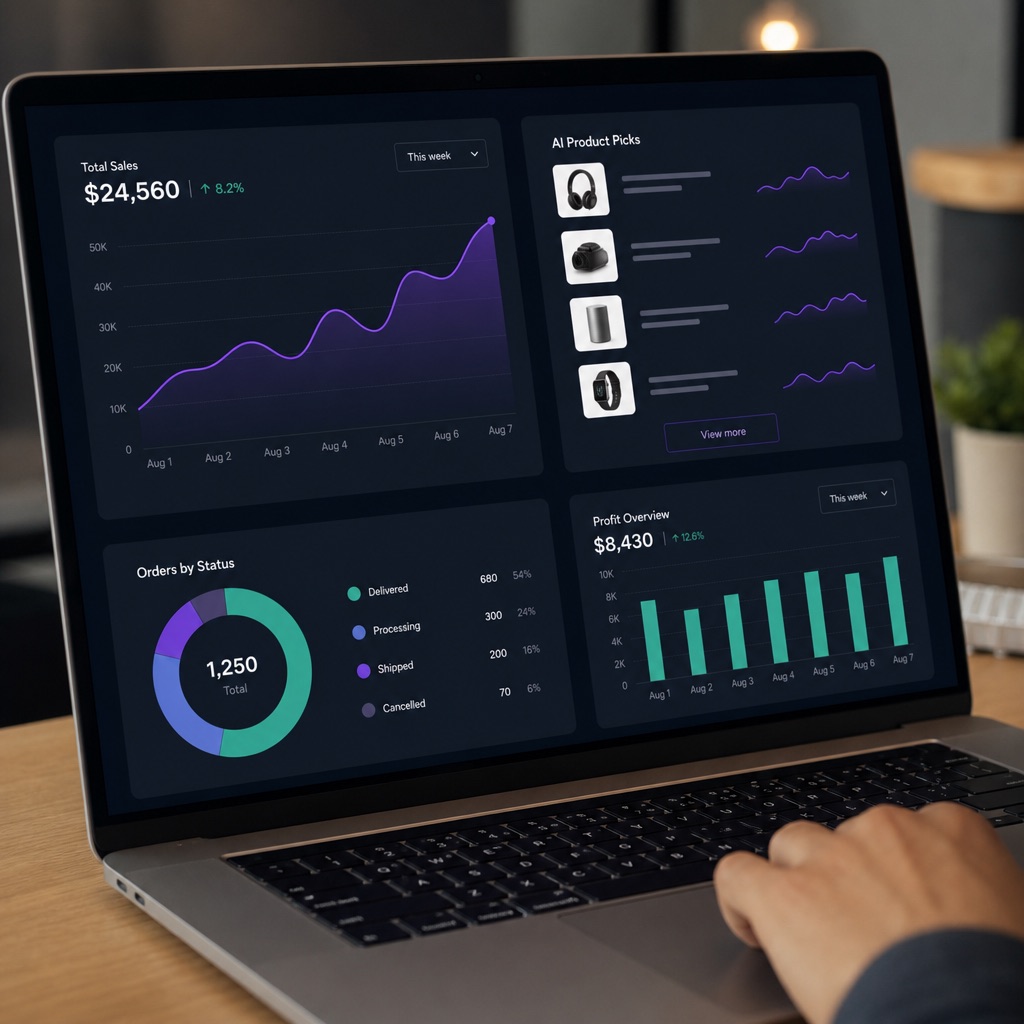
Popular AI Tools Used in Dropshipping (2026 Snapshot)
The tooling landscape shifts quickly, but as of late 2026 a few categories have stabilized enough to be worth understanding clearly.
| Tool Category | Example Use Case | Typical Monthly Cost Range |
|---|---|---|
| Product research AI | Trend scanning, demand forecasting | $30 – $100 |
| AI copywriting | Product descriptions, email flows | $20 – $80 |
| AI chat/support agents | Automated customer service | $50 – $200 |
| AI ad creative generators | Image/video ad variations | $30 – $150 |
| AI store builders | Rapid site/theme generation | $0 – $60 |
Pricing varies widely based on order volume and feature tiers, and many platforms bundle several of these categories together. The important thing isn't picking the "best" tool — it's picking tools that integrate with your existing stack (Shopify, WooCommerce, or similar) without creating duplicate work. Shopify's app ecosystem is a reasonable starting point for vetted, store-compatible AI integrations rather than standalone tools that require manual data transfer. For the specific tools I use and how they fit together, see The AI Tool Stack I Use to Run a Lean Store.
Common Mistakes People Make With AI Dropshipping
Because AI lowers the barrier to launching a store, it also lowers the barrier to launching a bad store quickly. Some recurring mistakes worth flagging:
- Trusting AI product suggestions without supplier verification. AI can spot a trending product; it cannot verify that your specific supplier ships it reliably in under two weeks.
- Publishing unedited AI copy. Generic, obviously AI-written product pages hurt trust and conversion rates. Google's own guidance on helpful content explicitly warns against publishing content that reads as automated and low-value.
- Over-automating customer service too early. A chatbot with no escalation path frustrates customers during disputes, which damages reviews and chargebacks.
- Ignoring unit economics. AI tools can make it feel like you're moving fast, but fast movement toward a product with 8% margins is still a losing strategy.
- Skipping financial organization. Many new store owners don't separate business and personal finances or track expenses properly until tax season becomes a crisis.
Is AI Dropshipping Still Profitable in 2026?
This is the question most newcomers actually want answered. The honest answer: yes, but the margin for error has shrunk because more operators are using the same AI tools, which compresses the advantage of speed alone.
Profitability in AI dropshipping now depends on:
- Niche selection discipline — broad, saturated niches (phone cases, generic jewelry) are brutally competitive even with AI tooling.
- Brand differentiation — stores that look like templated AI output convert worse than those with clear positioning and real product photography.
- Supplier relationships — automated tools can't replace vetted, reliable suppliers with reasonable shipping times. The Federal Trade Commission's guidance on dropshipping and online retail is a useful reminder that advertising accuracy and delivery timelines are legal obligations, not just customer service nice-to-haves.
- Customer experience — fast shipping, responsive support, and honest marketing still drive repeat purchases and reviews more than any AI tool.

Scaling From Side Project to $10K Months
Scaling is where most AI dropshipping advice online gets vague, often because the people writing it haven't done it themselves. A realistic scaling path tends to follow this pattern:
- Prove one product with consistent profitability over 4-6 weeks before investing further.
- Reinvest in creative testing, using AI tools to generate ad variation volume rather than relying on one or two creatives.
- Build retention mechanics — email flows, SMS, loyalty incentives — since repeat customers are dramatically cheaper than new ones.
- Automate reporting so you're reviewing weekly profit-and-loss data rather than guessing based on ad platform dashboards alone.
- Diversify traffic sources once one channel (say, Meta ads) becomes unreliable or expensive, testing TikTok, Google Shopping, or influencer partnerships.
- Systematize finance and operations, which is usually the unglamorous step that actually prevents a profitable store from collapsing under its own admin burden.
I go deeper on this stage — the real bottlenecks, the leverage points, and where to spend your time — in From First Sale to First $10K Month.
AI Agents vs. Simple AI Tools: Know the Difference
A distinction worth making clearly: most "AI dropshipping" content online refers to simple AI tools — single-purpose software that generates text, images, or research reports when prompted. A smaller but growing category involves AI agents: systems that can take multi-step actions autonomously, such as monitoring supplier stock levels, adjusting pricing, and flagging anomalies without a human triggering each step.
| Feature | Simple AI Tool | AI Agent |
|---|---|---|
| Operation | Single prompt, single output | Multi-step, autonomous action |
| Example | Generate a product description | Monitor inventory and reorder automatically |
| Oversight needed | Review each output | Set rules, audit periodically |
| Risk level | Low | Medium-High (errors can compound) |
| Current maturity (2026) | High | Still emerging, improving quickly |
Agents represent the next real leap for the industry, but they also carry more risk — an agent that mispriced inventory overnight because of a bad data feed is a real failure mode, not a hypothetical one. Most experienced operators recommend starting with simple tools, building strong manual oversight habits, and only layering in autonomous agents once you trust the underlying data sources.
Final Thoughts on AI Dropshipping
AI dropshipping isn't a shortcut to a business that runs itself — it's a set of tools that, used well, let a lean operator move faster through research, content, and support tasks that used to eat entire days. The stores that succeed in this environment aren't the ones using the most AI tools; they're the ones that pair AI efficiency with real supplier vetting, honest marketing, and disciplined financial tracking.
If you're serious about building or scaling an AI-assisted e-commerce business, the rest of my articles cover product sourcing, store building, and scaling in more depth: tested, no-hype workflows rather than theoretical advice. The goal is always the same — separating what actually works in AI dropshipping from what simply sounds good in a thumbnail.