
Dropshipping in 2026 looks very different from how it looked five years ago. Margins are tighter, customers are savvier, and the stores doing well are the ones using AI as a real operational advantage, not a buzzword. If you've been wondering how to use AI for dropshipping in a way that actually affects your bottom line, this article breaks it into seven concrete, testable workflows: product research, store setup, customer support, ad creative, supplier management, content, and analytics.
This isn't a theoretical overview. These are the categories of tools and processes practical e-commerce builders rely on every day. I've been a software engineer for more than 10 years, I've built 125+ custom apps for clients, and I run my businesses on AI agents, so I look at this as a systems question: which steps can a machine do reliably, and which ones still need a person?
1. Use AI for Product Research and Validation
The biggest lever in dropshipping has always been product selection, and it's also where AI pays back your time the fastest. Instead of scrolling through hundreds of marketplace listings by hand, AI tools can scan trend data, social signals, and marketplace metrics at the same time.
Here's a practical workflow:
- Use an AI-powered trend research tool to pull products with rising engagement across TikTok and Meta ad libraries.
- Feed the shortlist into a large language model with a structured prompt asking it to score each product against clear criteria: problem-solution fit, margin potential, shipping weight, and seasonality.
- Cross-check search demand with public search-trend data to confirm the product isn't a short-lived spike.
- Vet supplier reliability directly (pricing, shipping times, reviews, and a sample order) before committing any budget.
The key shift is that AI doesn't replace your judgment. It compresses the research phase from days to hours. A well-structured prompt can work through dozens of product listings in the time it used to take to review a handful by hand. I walk through this process step by step in How to Use AI Product Sourcing to Find Winning Items Before Your Competitors Do.
2. Build and Optimize Your Store Faster With AI Page Builders
Once you've validated a product, the next bottleneck is building the store. AI-assisted builders inside Shopify, along with standalone tools, can draft product descriptions, suggest layouts, and even produce full landing pages from a single prompt.
Practical applications include:
- Copywriting: Generate several product description variants aimed at different customer pain points, then A/B test them.
- Visual merchandising: AI image tools can remove backgrounds, upscale supplier photos, and create lifestyle mockups without a photoshoot. Real photos of a product you've actually sampled still build more trust, so use both.
- Page structure: AI page-building assistants can draft a full product page layout based on what's already working in your niche.
| Task | Manual Effort | AI-Assisted Effort | Typical Tool Type |
|---|---|---|---|
| Product description | Written one at a time | Fast first draft, then an edit pass | Large language model |
| Background removal | Image-by-image editing | Batch processing | AI image editor |
| Landing page draft | Hours of layout work | A working draft to refine | AI page builder |
| Store theme customization | Manual tweaking | Guided suggestions | Built-in store platform AI features |
This isn't about cutting corners. It's about putting the hours you save into testing more offers, which is where revenue growth actually comes from. If you want to see how I'd put the whole thing together, read Build Your First AI-Run Store in a Weekend.
3. Automate Customer Support With AI Chatbots
Customer service is often the first task founders neglect as order volume grows, and it's also one of the easiest to automate well. Modern AI chatbots go well beyond scripted FAQ bots. Many can read order status directly from your store, handle returns logic, and escalate only the complex tickets to a human.
Support tools in this category usually fall into a few tiers:
- Helpdesk platforms with built-in AI that plug natively into Shopify, a good fit for mid-size stores
- Lightweight chat widgets with an AI agent for smaller stores that need basic automation
- Enterprise support suites with AI agents for higher-volume brands that need more nuanced handling
A well-configured AI support layer can take many routine tickets (shipping delays, order status, return requests) off your plate. That frees you to focus on sourcing and marketing instead of inbox triage.
| Support Setup | Best For | Store Integration | What to Check Before Buying |
|---|---|---|---|
| Helpdesk with AI macros | Mid-size stores | Native apps | Per-ticket or per-resolution pricing |
| Chat widget with AI agent | Small, early-stage stores | Usually yes | Whether it hands off to a human cleanly |
| Enterprise AI support agent | Higher-volume brands | Yes | Custom pricing and setup time |
| Multi-channel support suite | Teams covering email, chat, and social | Yes | Seat costs as the team grows |
4. Let AI Write and Test Your Ad Creative
Paid advertising is still the main growth channel for most dropshipping stores, and AI has changed how creative gets made and iterated. Instead of commissioning a handful of ad variations and waiting weeks for results, you can generate dozens of hooks, scripts, and visual concepts in a single sitting.
Practical steps:
- Use a large language model to write 15 to 20 ad hook variations based on your product's core benefit and your customer's main pain point.
- Turn the strongest hooks into video concepts with an AI video tool. If you use AI-generated presenters, follow the ad platform's disclosure rules and never present a synthetic person as a real customer.
- Run small daily budgets on Meta or TikTok, split across variations, to find winners before you scale spend.
- Feed the performance data back into your model to sharpen the next batch of hooks. That closes the loop between creative and real results.
This generate, test, refine cycle is where AI earns its keep in dropshipping. Creative wears out on every major ad platform, and AI lets you refresh it faster and cheaper than traditional production.
5. Use AI Agents for Inventory and Supplier Management
As a store grows past a few dozen orders a day, manual fulfillment becomes a real liability. AI-driven automation can now handle much of this work.
Key use cases:
- Automated order routing to the right supplier based on stock levels and shipping zones
- Price monitoring agents that flag when a supplier's cost changes enough to hurt your margin
- Demand forecasting that uses your sales history to flag when to reorder or pre-stock inventory with a 3PL
Automation platforms connected to a language model's API, along with purpose-built dropshipping fulfillment apps, increasingly offer agent-style automation. The system doesn't just alert you to a problem. It takes a predefined action, like reordering stock or pausing a listing when a supplier runs out. For how these pieces fit together in practice, see The AI Tool Stack I Use to Run a Lean Store.
This is also where many beginners underestimate the complexity. The Federal Trade Commission's business guidance, including its rule on mail and internet order shipping, makes clear that sellers are responsible for their shipping promises even when third-party automation does the work. AI handles execution, but accountability stays with the store owner.

6. Apply AI to SEO and Organic Content for Your Store
Paid ads get most of the attention in dropshipping circles, but organic traffic compounds in a way paid traffic never does. AI has made it much easier to produce consistent SEO content, email sequences, and social posts without a full content team.
A sustainable content workflow looks like this:
- Use a keyword research tool to find low-competition, high-intent search terms related to your niche.
- Draft blog posts, buying guides, and comparison pages with a language model, then edit for accuracy and brand voice. Google's guidance on creating helpful content is worth reading before you publish anything AI-assisted.
- Repurpose written content into short video scripts for TikTok and Instagram Reels with AI editing assistants.
- Automate email flows (abandoned cart, post-purchase, win-back) using the AI copywriting features in your email platform.
The compounding effect matters here. A single well-optimized buying guide can keep bringing in traffic long after it's published, which no ad campaign does once the budget stops.
7. Use AI Analytics to Decide What to Scale
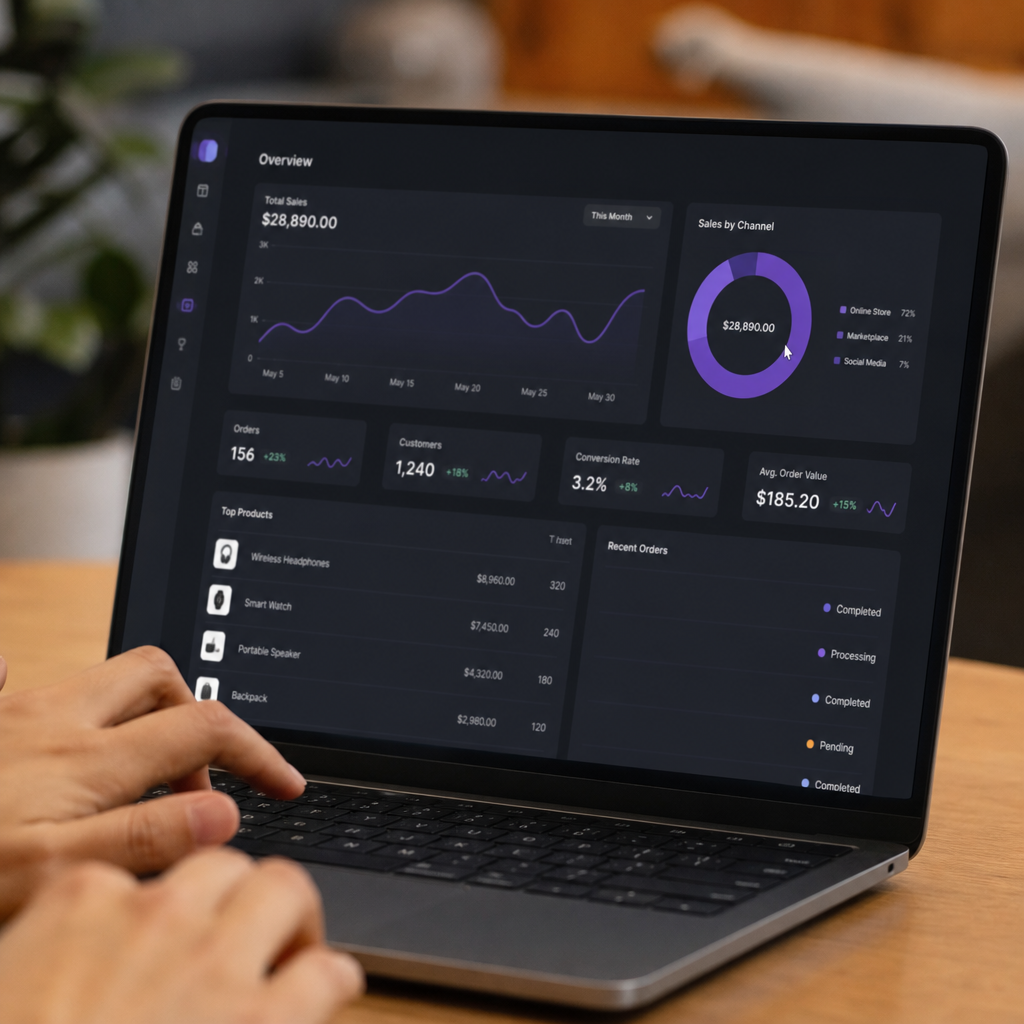
The last use of AI in dropshipping, and arguably the most important, is decision-making. Raw data means nothing without interpretation, and this is where many store owners either drown in dashboards or ignore the data entirely. AI-powered analytics tools can summarize performance trends in plain language and flag anomalies before they turn into expensive mistakes.
Practical applications:
- Anomaly detection: AI flags a sudden drop in conversion rate, often before you'd notice it yourself.
- Cohort analysis: See which traffic sources bring repeat customers and which bring one-time buyers.
- Scaling recommendations: Some platforms suggest specific budget increases based on how stable your ROAS is, instead of generic percentage rules.
| Analytics Focus | Traditional Approach | AI-Enhanced Approach |
|---|---|---|
| Spotting underperforming SKUs | Manual spreadsheet review | Automated weekly anomaly alerts |
| Customer segmentation | Basic demographic filters | Behavioral cohort modeling |
| Ad budget scaling | Fixed percentage rules | Dynamic, performance-based suggestions |
| Churn prediction | Rarely attempted manually | Predictive scoring models |
Dedicated e-commerce attribution platforms exist to solve exactly this problem, turning raw store data into decisions you can act on the same day. Before paying for one, start with your store platform's built-in analytics and a simple weekly profit-and-loss review. When you're ready to scale a winner, I cover the real bottlenecks in From First Sale to First $10K Month.
Common Mistakes When Using AI for Dropshipping
Even with the right tools, it's easy to use AI in ways that slow growth instead of speeding it up. Some of the most common mistakes:
- Publishing AI-generated product descriptions without fact-checking. Made-up specifications lead to returns and chargebacks.
- Skipping human review on ad creative, which leaves you with generic messaging that blends into the feed.
- Automating customer support too aggressively and frustrating customers who need a real person for complex issues.
- Treating AI trend data as guaranteed demand instead of one input among several.
- Ignoring platform policies. Store platforms and ad networks have rules about automated messaging, product claims, and advertising, so check the Shopify Help Center and your ad platform's policies before you automate.
The pattern across all of these is the same: AI should speed up your judgment, not replace it. The stores that scale sustainably treat AI as leverage on a sound strategy, not a substitute for one.
Building a Realistic AI Dropshipping Workflow
Pulling all seven areas together, a realistic weekly rhythm for a lean, AI-assisted dropshipping store might look like this:
- Monday: Run AI trend analysis for new product candidates and shortlist 3 to 5 for a closer look.
- Tuesday: Generate and edit product page copy and images for the products that passed validation.
- Wednesday: Draft and launch a fresh batch of ad creative variations using AI script generation.
- Thursday: Review AI analytics summaries and decide which campaigns to scale, pause, or kill.
- Friday: Check how well automated support is resolving tickets, refine the chatbot flows, and publish one piece of AI-assisted SEO content with its social repurposing queued.
This cadence keeps the business moving without a large team, which is the whole premise behind lean, AI-powered e-commerce.
Final Thoughts
Learning how to use AI for dropshipping isn't about chasing every new tool that launches. It's about finding the handful of workflows that genuinely save time or improve decisions, and building consistent habits around them. Product research, store building, customer support, ad creative, inventory management, content, and analytics each give AI a clear place to do real work in your business, as long as you're the one making the final calls.
The founders getting consistent results in 2026 aren't the ones with the most tools installed. They're the ones who built a repeatable system and stuck with it long enough to refine it. If you want more on any single piece of this, the rest of my articles go deeper on sourcing, tools, and scaling.