
E-commerce used to reward whoever could hire the biggest team. Today, it increasingly rewards whoever can build the smartest system. AI ecommerce automation has quietly become the dividing line between store owners grinding through fourteen-hour days and those running lean, profitable operations with a fraction of the headcount.
This isn't about replacing judgment with algorithms. It's about using AI tools and agents to handle the repetitive, data-heavy work (product research, customer support triage, inventory syncing, ad copy generation) so founders can spend their limited time on strategy and relationships. Below, I break down six concrete ways this shift is changing how lean stores get built and run.
1. Product Sourcing Gets Faster and More Precise
Manual product research used to mean scrolling through supplier catalogs and trend reports for hours, hoping to spot a winner before the market got saturated. AI-powered sourcing tools now compress that process dramatically by analyzing search trends, social engagement, and sales velocity at the same time.
Modern sourcing workflows typically combine:
- Trend detection models that flag rising search volume before it peaks
- Social listening tools that track TikTok and Instagram engagement on product categories
- Supplier scoring systems that weigh shipping times, reviews, and margin potential
- Competitor tracking to see what similar stores are already selling successfully
The result is a shortlist of viable products in minutes instead of days. You still have to validate margins and suppliers yourself, but the first pass is no longer the bottleneck. I walk through the full workflow in How to Use AI Product Sourcing to Find Winning Items Before Your Competitors Do.
2. Store Build-Out Shrinks From Weeks to Days
Launching a store traditionally required a designer, a copywriter, and someone who understood conversion-rate basics. AI tools have collapsed that timeline by generating product descriptions, theme layouts, and even basic UX recommendations based on proven templates.
A typical AI-assisted build now looks like this:
- Generate a product catalog with AI-written titles, descriptions, and SEO metadata
- Use an AI design assistant to select and customize a storefront theme
- Auto-generate policy pages, FAQs, and shipping information
- Run an AI audit for page speed and mobile responsiveness
- Launch with a baseline conversion-rate optimization checklist already applied
This isn't a shortcut that sacrifices quality. It's a reordering of priorities. Founders still need to review and refine the output, but the heavy lifting of first drafts is automated. Major platforms like Shopify now build AI writing and setup help directly into the store admin, which tells you this is a platform-level change, not a fringe trend.
3. Customer Support Runs Without a Full-Time Team
Support used to be the first hire a growing store made. Now, AI chat agents handle a meaningful share of tier-one inquiries (order status, return policies, sizing questions) without human intervention, escalating only the complex cases.
| Support Function | Manual Approach | AI-Automated Approach |
|---|---|---|
| Order status inquiries | Staff checks system, replies manually | Chatbot pulls live order data instantly |
| Return/refund requests | Email back-and-forth, often taking a day or more | Policy-based approval for routine cases |
| Product questions | Staff searches specs, replies | AI references product catalog in real time |
| Escalations | Routed by inbox sorting | Flagged automatically by sentiment analysis |
| Multilingual support | Requires bilingual staff | Handled natively by AI translation |
AI doesn't eliminate the need for human support entirely, but it can absorb a large share of routine tickets. That frees founders or small teams to focus on retention, refunds that need judgment, and brand voice.
4. Inventory and Supplier Coordination Becomes Predictive
One of the more underrated applications of AI ecommerce automation is inventory forecasting. Instead of reactively reordering stock after it runs out, or tying up cash in excess inventory, AI models analyze historical sales data, seasonality, and even external factors like shipping delays to predict what's needed and when.
Benefits store owners typically look for include:
- Fewer stockouts during demand spikes
- Less dead stock sitting in warehouses
- Better cash flow planning around reorder cycles
- Early warnings when a supplier's fulfillment times are slipping
Inventory mistakes are one of the classic ways a small business runs short on cash, and forecasting tools address that risk directly by turning guesswork into pattern-based prediction.
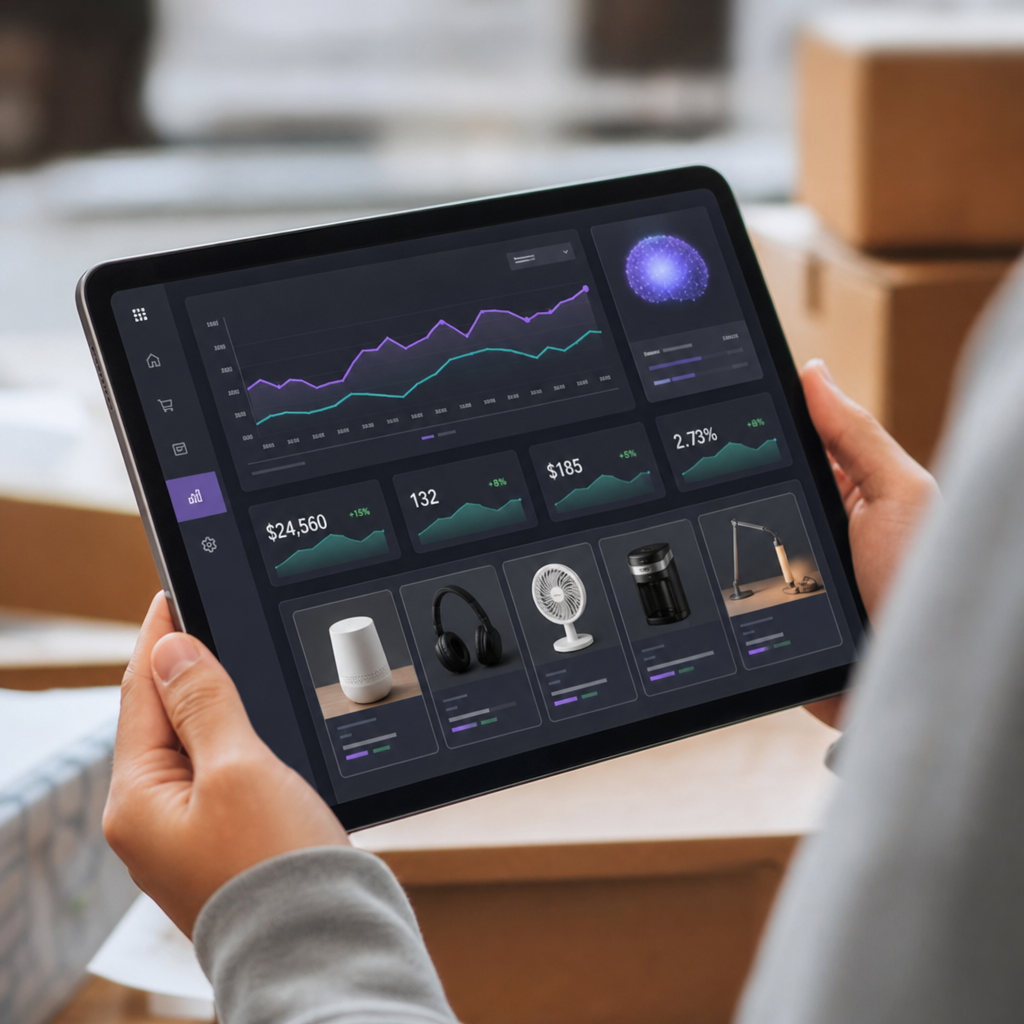
5. Marketing Content Production Scales Without a Content Team
Perhaps the most visible shift has been in marketing. AI copywriting and creative tools now generate ad variations, email sequences, and product page copy at a volume no single founder could produce by hand. This matters because e-commerce success is often a numbers game: the more ad variants and email tests you can run, the faster you find what converts.
A side-by-side comparison of output capacity shows the shift:
| Task | Solo Founder (Manual) | Founder + AI Tools |
|---|---|---|
| Ad copy variations per week | A handful | Dozens |
| Email sequences per month | One or two | Several |
| Product descriptions per day | A small batch | A full catalog |
| A/B test cycles per month | Few | Many more |
This doesn't mean quality is guaranteed at scale. AI output still needs editing and brand alignment. But the raw capacity to test more, faster, is a real advantage for lean teams competing against larger, better-funded stores. For a tool-by-tool breakdown of what's worth paying for, see 9 Best AI Tools for E-Commerce That Can Cut Your Workweek From 40 Hours to 10.
6. Financial and Operational Tracking Becomes Automated
Running a lean e-commerce business means wearing every hat, including bookkeeper. AI-powered financial tools now reconcile transactions, flag unusual spending patterns, and generate cash flow projections automatically. This matters more than it sounds like it should, because cash flow problems sink plenty of small operations even when revenue looks healthy on paper.
Founders managing multiple subscriptions, ad accounts, and supplier payments benefit most from getting all of that spending visible in one place early. The same discipline that automates a store's operations can also take routine decisions off the founder's plate, which lowers the risk of burning out.

Choosing the Right AI Stack Without Falling for Hype
With dozens of tools claiming to be "AI-powered," the real challenge isn't access. It's selection. A practical filter for evaluating any AI ecommerce tool should include:
- Does it solve a task you currently do manually and repetitively?
- Can you measure the time or cost saved within 30 days?
- Does it integrate with your existing platform (Shopify, WooCommerce, etc.) without custom development?
- Is there a free or low-cost tier to test before committing?
Tools that fail this filter tend to be the ones sold on hype rather than workflow value. I cover where this goes wrong in The Biggest Mistakes Sellers Make When Deploying AI Agents for E-Commerce.
The Realistic Limits of AI Ecommerce Automation
It's worth being direct: AI automation is not a replacement for product-market fit, customer trust, or basic business fundamentals. Stores that lean entirely on automated sourcing and AI-generated marketing without a differentiated offer tend to plateau quickly. The founders who get the most out of it treat AI as a force multiplier on top of solid fundamentals, not a substitute for them.
A few realistic limitations worth planning around:
- AI trend predictions can surface false positives, especially in saturated niches
- Automated customer support still requires human oversight for brand tone and edge cases
- AI-generated content needs editing to avoid generic, templated language that hurts conversion. Google's guidance on helpful content is worth reading before you publish anything at scale.
- Forecasting models need several months of sales data before predictions become reliable
Understanding these limits upfront prevents the common mistake of over-automating before a store has enough operational history to make automation meaningful.
Building a Realistic 90-Day Automation Roadmap
For founders wondering where to start, sequencing matters more than tool selection. A reasonable 90-day approach looks like this:
Days 1-30: Foundation
- Automate product research and shortlisting
- Set up AI-assisted store build and product descriptions
- Establish baseline analytics tracking
Days 31-60: Operations
- Deploy an AI chat agent for tier-one support
- Implement inventory forecasting once initial sales data exists
- Begin testing AI-generated ad variants at small budget levels
Days 61-90: Scaling
- Expand successful ad creative using AI generation at volume
- Automate financial tracking and reporting
- Review which tools delivered measurable ROI and cut the rest
This phased approach avoids the common trap of adopting ten tools at once and losing track of what's actually driving results. If you're past launch and thinking about growth, I go deeper on that stage in From First Sale to First $10K Month.
Final Thoughts
AI ecommerce automation isn't a single tool or a magic shortcut. It's a layered set of capabilities that, used deliberately, let lean teams compete with far larger operations. The founders who do well with it aren't the ones chasing every new AI release. They're the ones who pick the three or four automations that genuinely move the needle on sourcing, support, content, and finances, then run them consistently.
Start with one repetitive task you do every week, automate it, measure it, and only then add the next one.