#ad: Sponsored by FrontRank.
I asked ChatGPT who makes YouTube videos about using AI for side hustles. I was kind of hoping I'd be one of the answers. I wasn't.
Then I got more specific: who makes YouTube videos about using AI agents for dropshipping? That's my specialty. I've made a lot of those videos. I still wasn't on the list.
When AI builds a list like that, it leans on what's written about people across the web: articles, reviews, other sites that mention them. My own website is the one piece I control 100%, so I started there.
Why this matters
A lot of people don't Google things anymore. They ask ChatGPT. If you have a store, a side hustle or a local business, you want to be on the list ChatGPT gives people. If someone asks for the three best options in your niche and you're not one of them, they're probably not going to find you.
So I wanted to test two things:
- Does AI know my site exists?
- Does it recommend me when someone asks a question in my niche?
I asked ChatGPT "what is jamespelton.me?" It knew the site. It said it was the personal website of a software developer, entrepreneur and YouTube creator. That's good, but the answer was vague. It didn't mention my articles, and it didn't say anything a person would act on, like contacting me for a website, an app or a YouTube video.
The audit
Here's what I checked on my site, in order.
robots.txt
This file tells bots, including the AI ones, what they're allowed to read. Mine allows everything and points to my sitemap, so it wasn't blocking anything. On your site, look for lines that mention GPTBot, ClaudeBot or PerplexityBot. If one says "Disallow: /", that tool isn't allowed to crawl your site. Some hosts and security tools add that for you, so it's worth checking.
sitemap.xml
The sitemap is a list of every page on your site, so a crawler doesn't have to go hunting. Shopify and WordPress set this up for you. If you built your own site, you might not have one. Mine looked good.
llms.txt
Mine said page not found. This was my first problem. An llms.txt file tells AI, in plain language, who you are, what's on your site and which pages matter. To be fair, it's a proposed standard, not an official one, and not every AI company says it reads it. But it costs nothing to add. There was nothing on my site that summed up who I am, and that's exactly what this file is for.
Canonical tags
A canonical tag tells search engines which address is the real one for each page, so the same page doesn't get counted twice. I viewed the page source and found zero. I don't know how I missed that.
Schema markup
This is a small block of code that tells machines, in plain facts, who you are and what your site is for. Think of it as a business card for your site. It doesn't change what people see. Google has used schema for a long time for things like star ratings and FAQ boxes, and AI can read the same block. I didn't have it either.
That's three fixes.
Fixing it with Claude Code
I opened Claude Code and told it what I wanted in plain English:
Make my website easier for AI assistants like ChatGPT to read. Add an llms.txt file that describes the site, add schema markup about me and the site, and add a canonical tag to every page.
It added the llms.txt file, the schema markup and the canonical tags. Then I had it deploy to Netlify, where I host the site. It knows the commands, so I didn't have to look them up. I checked the live site: llms.txt had my info, and the page source had a canonical tag.
I could have done this by hand, but adding a canonical tag to every page would be pretty annoying. If you're on Shopify, Wix or WordPress, you probably don't need Claude Code for this.
The other half: content
Fixing the technical side is half the job. The other half is having content on your site that matches what people are actually searching for.
That's where FrontRank comes in. It finds the keywords people search for in your niche, writes articles around them and publishes them to your site. It works with WordPress, Shopify, Wix and Webflow.
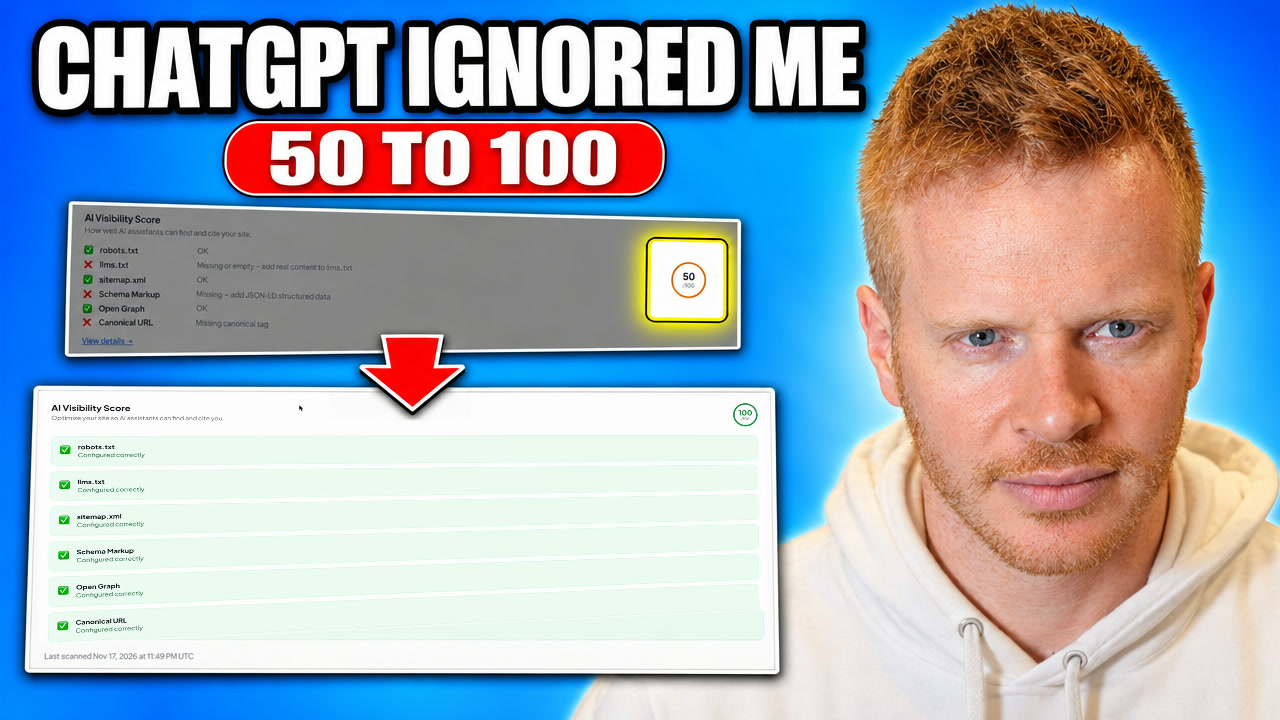
When I added my site, it gave me an AI visibility score out of 100 and flagged some of the problems I'd found by hand. After my fixes, I rescanned and got 100 out of 100.
Then it found keywords for my niche, like "how to use AI for dropshipping" (2,400 searches a month) and smaller ones like "AI for product sourcing dropshipping" (320 a month). It turned those into a content calendar. I have mine set to save every article as a draft for me to read and approve before I post it.
Does this guarantee you show up?
No. Nobody outside these companies knows exactly how they pick who to recommend. But you can put yourself in the best position to succeed.
I'm going to give it about a month, then ask ChatGPT again and see if I show up.
If you want to try FrontRank, there's a free three-day trial: frontrank.com
Have you asked ChatGPT about your own business yet?